 Masai Mara
4-Day Masai Mara Safari
Two full days in the reserve — the itinerary we recommend for migration season and realistic crossing chances.
From $560 per person
View 4-Day Itinerary
What the migration actually is, when the herds reach the Mara, how river crossings really work — and how to plan a safari around an event no one can schedule.
Last updated:
The Great Migration is not a single event but a year-round circular movement of roughly 1.5 million wildebeest — the figure is an estimate, and it varies year to year — together with hundreds of thousands of zebra and gazelle, looping endlessly around the Serengeti–Mara ecosystem. The herds follow the rain, and the rain moves the grass: south to the Serengeti's calving grounds around the turn of the year, then clockwise north and west as the seasons dry, until the search for grazing pushes them across the border into Kenya's Masai Mara.
It helps to drop the documentary framing for a moment. The animals are not "performing" anything; they are eating their way around a giant circuit, calving, drowning, being hunted and multiplying as they go. That is precisely what makes it worth seeing — it is a working ecosystem at full scale, not a staged spectacle. And because it is driven by weather, its timing shifts every single year.
The Mara is the northern arc of the circuit. In a typical year the leading herds begin crossing into the Mara from July, having exhausted the grazing in the northern Serengeti. Through August and September the reserve fills: columns of wildebeest strung across the plains, zebra mixed through them, and the resident predators presented with more food than they can use. The herds generally stay through October, shuttling between the Mara and the northern Serengeti as local grazing dictates.
Then the short rains arrive — usually around November — greening the plains to the south, and the herds answer by turning back into the Serengeti and beginning the long swing towards the calving grounds. "Typically" is the load-bearing word in all of this: an early or late rainy season can shift arrival and departure by weeks, which is why we talk in windows, not dates.
The image everyone carries is the Mara River crossing: thousands of wildebeest funnelling down a bank into brown water, crocodiles waiting, dust and spray everywhere. Crossings do happen, repeatedly, through the season — the herds cross and re-cross as grazing shifts — but here is the honest part: no guide, ours included, can guarantee you one. Herds will mass at a crossing point for hours, lose their nerve at a swirl in the water, and walk away. They will also pour across a quiet bend with no warning at all while every vehicle waits two kilometres upstream.
What improves your odds is simple: time and patience. Guides read the build-up — herds bunching near the river, lead animals testing the bank — and the travellers who see crossings are usually the ones willing to wait at a likely point rather than chase rumours around the reserve. This is also the plainest argument for an extra day in the reserve: a 4-day safari gives you two full days in the migration sectors instead of one, which roughly doubles your realistic chances without doubling your budget — from $820 per person in the high season.
In season, the action concentrates in two areas. The Mara River sector, in the west of the reserve, is where the classic crossings happen — this is where you spend the patient hours. The Talek area, near the reserve's eastern gates, puts you among big herds on the plains, dense predator activity, and most of the budget and mid-range camps, with quick gate access for first-light starts. A good migration itinerary uses both: early starts from the Talek side, full days working towards the river, picnic lunch out, back after the light goes soft.
Vehicle numbers are at their annual peak in these months, and popular crossing points can get crowded when a herd builds up. Early starts help; so does a guide who is happy to leave a fifty-vehicle scrum and find a quieter stretch of river.
Migration season is the most expensive time in the Mara — park fees are at the $200-per-day high-season rate and camps charge their peak prices — but it is emphatically not a luxury-only event. Our group joining departures run right through the season: you share a vehicle with up to six other travellers, sleep in a budget tented camp outside the gates, and drive exactly the same river sectors as the $1,000-a-night lodges. In high season a 3-day group joining safari starts from $650 per person, all-inclusive of park fees, meals and game drives.
The trade-offs are the usual ones — fixed departure dates, shared vehicle, simple accommodation — and none of them touches what you actually came for. The wildebeest do not know what your camp costs.
If you measure the migration only in river crossings, you can have an extraordinary safari and still feel you "missed it". Widen the lens. The predator action in these months is the best of the year: lion prides gorging and bold, cheetah hunting in daylight, hyena clans working the herd edges every morning. And the sheer scale is a spectacle in itself — herds stretching to the horizon in every direction, the constant grunting of hundreds of thousands of animals, the smell and the dust of it. Many travellers rate an hour parked inside a mega-herd above the crossing they queued for.
For a different perspective altogether, a dawn balloon flight (around $450 per person) puts you a few hundred feet above the herds as the sun comes up — arguably the only way to comprehend the migration's true size. It books out fast in season, and it is a fixture of our honeymoon safari for couples who want one unrepeatable morning built into the trip.
Tell us your dates and group size — we'll reply on WhatsApp with an honest read on the season and an itemised quote.
Two full days in the reserve — the itinerary we recommend for migration season and realistic crossing chances.
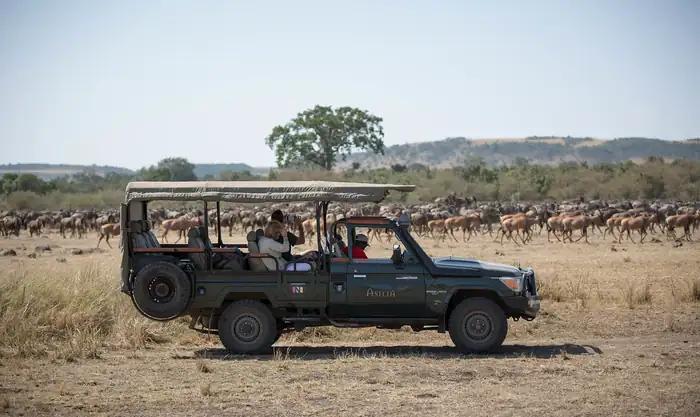
Shared departures running right through migration season — the same river sectors at the lowest per-person price.